Lunigiana
Surroundings
Beyond the gate, the silence of woods and ridges. And when you feel like venturing out, the sea half an hour away and a hundred castles within a day: from Castevoli you can reach almost everything worth the journey.
Lunigiana
Beyond the gate, the silence of woods and ridges. And when you feel like venturing out, the sea half an hour away and a hundred castles within a day: from Castevoli you can reach almost everything worth the journey.
First of all
Before the sea and the castles, Castevoli’s most precious asset is silence. Here you are surrounded by nothing at all — woods, ridges, the wind in the chestnut trees and the sound of the Geriola stream — and that, these days, is a rare treasure.
Far from traffic and stress, the day is paced by the sounds of nature. From slow walks in the woods, with the valley opening at every bend, to steeper climbs toward the peaks that close the horizon, where the view takes your breath away. And in the right season, with a basket and a little patience, you come home with mushrooms.
And when you do feel like travelling, there is all the rest: the sea, the castles, the great art cities, all within a day’s reach.
What to see
Lunigiana is the “land of a hundred castles”: in the Middle Ages every hilltop, every bend of the Magra had its stronghold, almost always a Malaspina one. If medieval castles are your thing, this is heaven — around Castevoli you can count them by the dozen. Tap a marker on the map to discover them.
Choose a castle
Tap any marker and its card opens: the larger ones are Lunigiana’s well-known castles, the smaller ones the strongholds of the countryside a stone’s throw from Castevoli.
The great castles of Lunigiana
Pontremoli
At the northern edge of Lunigiana, the Piagnaro has watched over Pontremoli and the passes of the Via Francigena since the 11th century. It takes its name from the “piagne”, the sandstone slabs of the region’s roofs, and today it houses the celebrated Museum of the Statue Stelae.
The great castles of Lunigiana
Fosdinovo
Perched on the heights that overlook the Magra plain all the way to the sea, it is among the best-preserved castles in Lunigiana. It was the court of the Malaspina of the Spino Fiorito branch, from 1340 the marquisate of Spinetta “the Great”; tradition has it that Dante stayed here in exile.
The great castles of Lunigiana
Fivizzano
Not a simple castle but an entire fortified village: it was the stronghold of Spinetta Malaspina “the Great” in eastern Lunigiana. It keeps its medieval layout, with the armoury vaulted over a single octagonal pillar; from 1977 it was the home of the sculptor Pietro Cascella.
The great castles of Lunigiana
Aulla
A bastioned Renaissance fortress on a rocky spur, where the Magra meets the Aulella. Square in plan, with four corner towers and a deep moat; today it houses the Natural History Museum of Lunigiana.
The castles close to home
Mulazzo
Its fortified hamlet overlooks the right bank of the Magra facing Castevoli, and can be spotted from the motorway between Aulla and Pontremoli. A fief of the Malaspina of the Spino Secco — the same branch as Castevoli — it passed to the Medici in 1575; today it is home to the Museum of Emigration.
The castles close to home
Tresana
It rises on a sheer crag above the Osca plain, a little downstream from Castevoli. Its Malaspina marquises held the rare privilege of a mint and struck coin here from 1571; after centuries of ruin it has been under restoration since 2010.
The castles close to home
Villafranca in Lunigiana
Unmistakable for its slender cylindrical tower, over twenty-five metres high and among the finest in Lunigiana. It guarded the right side of the valley as a hinge between Bagnone, Villafranca and Filattiera; today it is restored and state-owned.
The castles close to home
Bagnone
A Malaspina castle of upper Lunigiana, long the seat of a vicariate. In the 1970s the bibliophile Loris Jacopo Bononi restored it and turned it into a centre of culture, gathering first editions and incunabula.
The castles close to home
Villafranca in Lunigiana
Its haunting ruins watch over Villafranca along the Via Francigena. It belonged to the same Ghibelline branch as Castevoli — the Malaspina of the Spino Secco — and in Dante’s day answered to Franceschino Malaspina of Mulazzo; almost intact until 1944, it was reduced to ruin by the war.
The strongholds of the countryside
Mulazzo
Capital of the Malaspina Spino Secco branch — the same as Castevoli — of its castle Mulazzo keeps only the Tower of Dante, all that remains of a 12th–13th-century stronghold. Tradition has it that Dante stayed here in exile: in the village the “House of Dante in Lunigiana” and the Malaspina Archive Museum preserve his memory.
The strongholds of the countryside
Mulazzo
A little above Mulazzo, Castagnetoli was the “Castle, or rather Palace” of a small imperial marquisate of the Malaspina of the Spino Secco. With Tresana and Giovagallo it passed to the Corsini in 1659; the memory of the marquis’s palace, later sold off, survives in the village, together with the old tradition of chestnut “pattone”.
The strongholds of the countryside
Mulazzo
It stands on the valley floor just below Castevoli, where the old road of the parish churches climbed toward the village along the Geriola stream. A square-plan fortification perhaps of the 11th–12th centuries, with a tower and a residential wing added later, now restored.
The strongholds of the countryside
Mulazzo
The centre of the old marquisate of Groppoli, on the right bank of the Magra, a fief of the Malaspina and later of the Genoese Brignole-Sale. The old castle, “in a rather alpine spot”, was abandoned when, in 1642, the marquises chose instead a new palace entrusted to the architect Giambattista Bianchi.
The strongholds of the countryside
Mulazzo
Seat of a small Malaspina fief that broke away from Mulazzo in 1573 and was reunited in 1647, set high toward the passes of the Francigena. Today Montereggio is famous as the “village of booksellers”: from its travelling book pedlars came bookshops all across Italy.
The strongholds of the countryside
Mulazzo
Perched above its hamlet, it was the marquis’s palace of the fief of Monteregio and Pozzo. Here, in 1646, the last marquis, Ottavio, took his own life: left without heirs, the fief returned to Mulazzo for good. Repetti recorded it as a “hamlet once a castle”, with its family chapel.
The strongholds of the countryside
Tresana
Of this Malaspina castle only romantic ruins remain, yet the name looms large in poetry: it was the fief of Moroello Malaspina “the Younger”, Dante’s “vapour of Val di Magra”, and of Alagia Fieschi, remembered in the Purgatorio. Made safe in 2023, it is celebrated as a Dantean site.
The strongholds of the countryside
Tresana
Among the best-preserved castles of the Tresana area: a compact 14th-century fortification, rectangular in plan, overlooking the hamlet of Castello di Villa, once a place of shelter for pilgrims on the Francigena. Tied to Villafranca since 1266, it is privately owned but clearly visible from outside.
Beyond the castles
But Lunigiana is more than castles: between one ridge and the next it guards stone villages and Romanesque parish churches, the enigmatic prehistoric statue stelae gathered in its museums, the gorges carved by its streams and the ruins of an entire Roman city — and, a short distance away, the beaches of Versilia and the Cinque Terre. Here is where to begin.
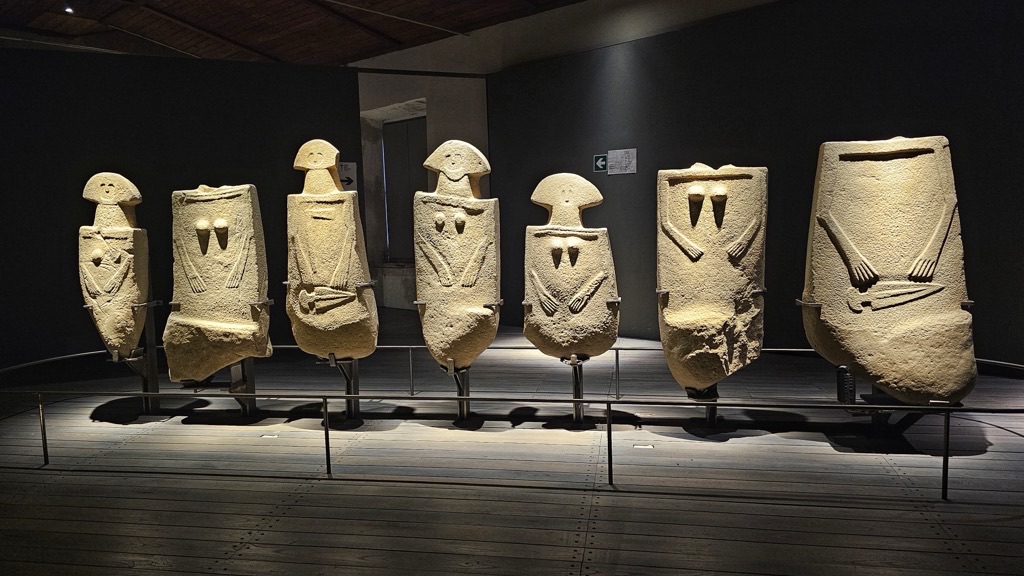 Photo: Cristina Maioglio · CC BY-SA 4.0
Lunigiana’s “documents in stone”: human figures carved between the Copper Age and the Iron Age, their faces barely sketched and enigmatic. They are gathered in the museum at Pontremoli, and some came from the territory of Mulazzo itself. Many resurfaced, reused as building stone: look carefully, and a fragment may still turn up in the wall of a house or a cellar.
Wikipedia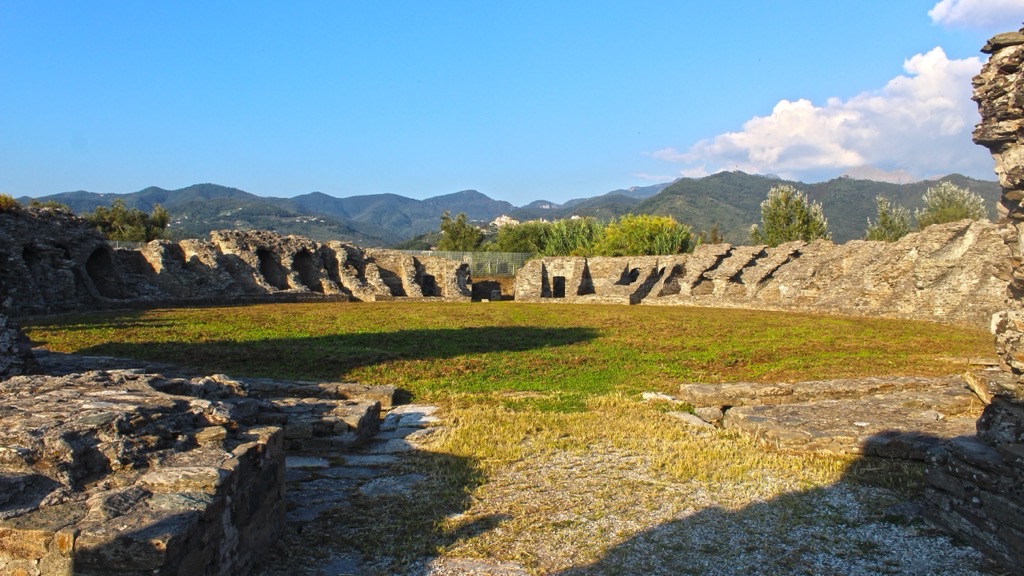 Photo: Phyo91 · CC BY-SA 4.0
The Roman city that gives its name to all of Lunigiana. Founded in the 2nd century BC, it was a great port shipping the marble of the Apuan Alps; then the sea withdrew and malaria emptied it, leaving it to the fields. Its ruins can be visited today — the amphitheatre, the forum and the mosaics — along with the archaeological museum that gathers the finds.
Wikipedia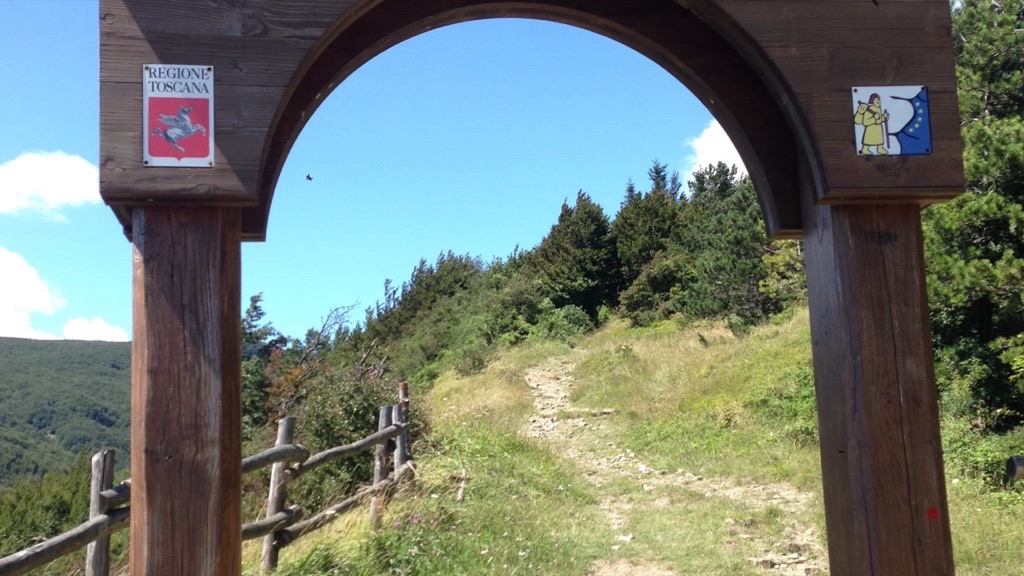 Photo: Paulusburg · CC BY-SA 4.0
The pilgrim and trade route that led from northern Europe to Rome. In Lunigiana it passes through Fornovo, Berceto and Pontremoli, crosses the Cisa pass and drops to the ancient port of Luni.
Wikipedia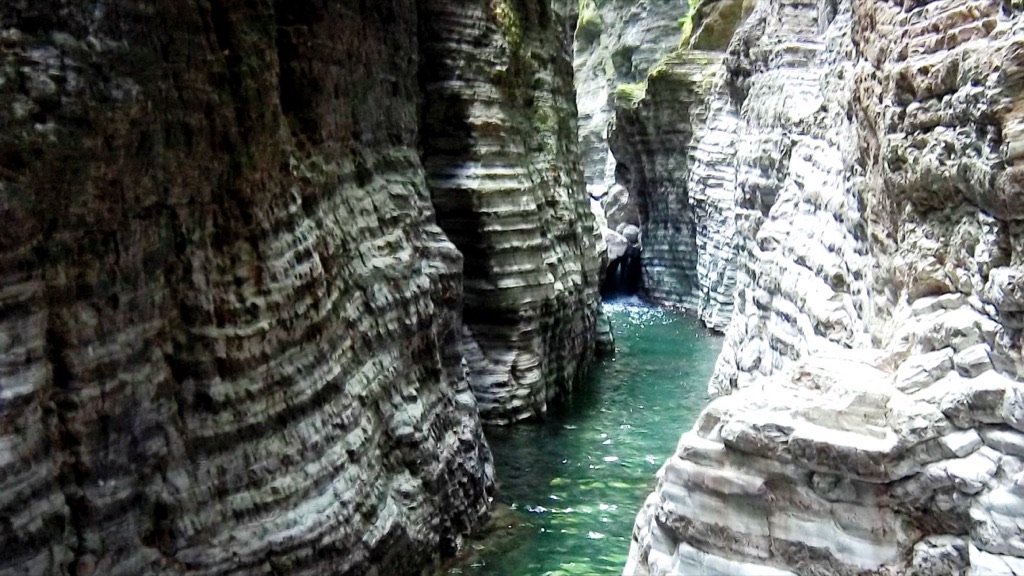 Photo: Farfalle in Cammino · CC BY-SA 4.0
The Piscio di Pracchiola, with its thirty-metre waterfall. Nearby, the Giaredo gorges and the Colombara cave, for those who want to immerse themselves in nature.
WikipediaGetting here
Castevoli is in Lunigiana, in the far north of Tuscany, where it meets Liguria and Emilia. The Cisa motorway (A15) and the Pontremoli railway station are a few minutes away; the rest is ridge, chestnut trees and roads that climb.
Castevoli, Mulazzo (MS) — 44°17′26″N 9°54′29″E · Open the map
Staying
There are those who, having passed through, decide not to leave. In summer the village community gathers, and some stone houses are just waiting for someone to reinvent them.
Living here